The building blocks of every fragrance. Learn about the natural and synthetic ingredients that create the scents you love.
What Are Fragrance Notes?
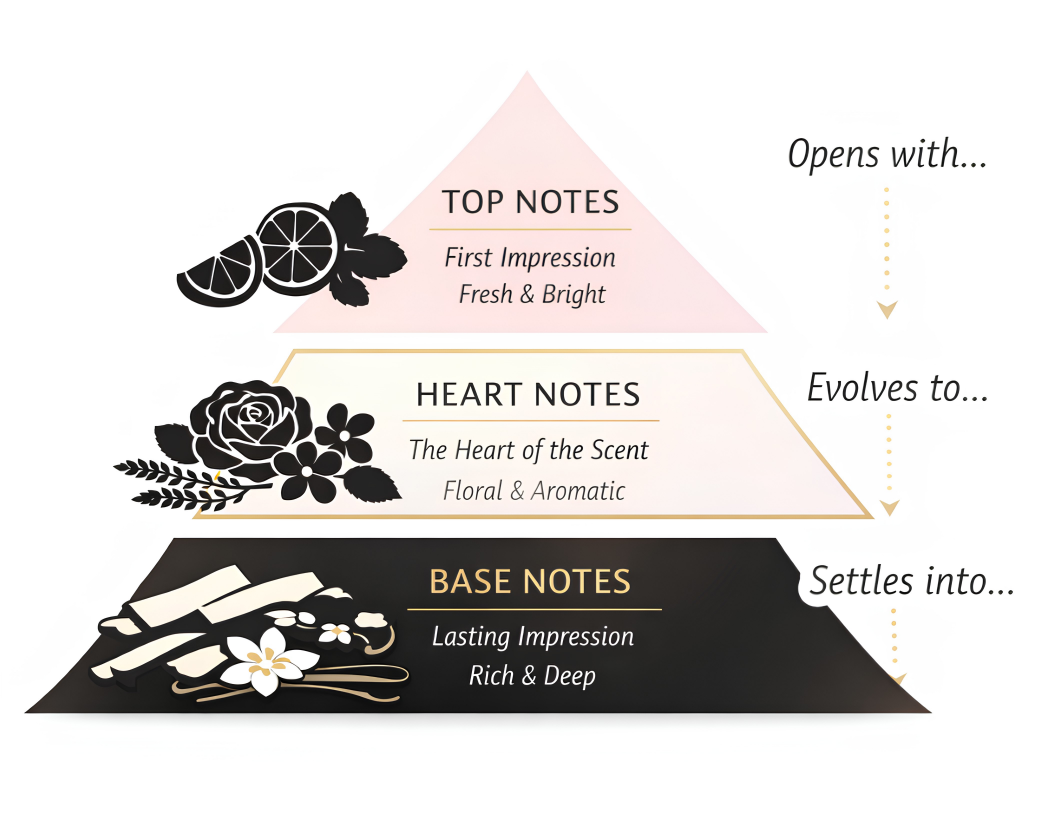
The three layers of every fragrance — top, heart, and base — unfold in sequence on your
skin.
Fragrance notes are the individual scent layers that make up a
perfume or cologne. Every fragrance is
composed of dozens of ingredients carefully blended together, and these ingredients are organized into
three tiers based on when you smell them: top notes, heart (middle) notes, and base notes.
Think of it like music. The top notes are the opening melody that
grabs your attention. The heart notes
are the chorus that defines the song. And the base notes are the bass line that holds everything
together long after the melody fades.
Understanding notes helps you predict whether you'll like a fragrance
before you even spray it, and it
helps you describe what you're smelling to others or to a fragrance advisor.
Top Notes: The First Impression
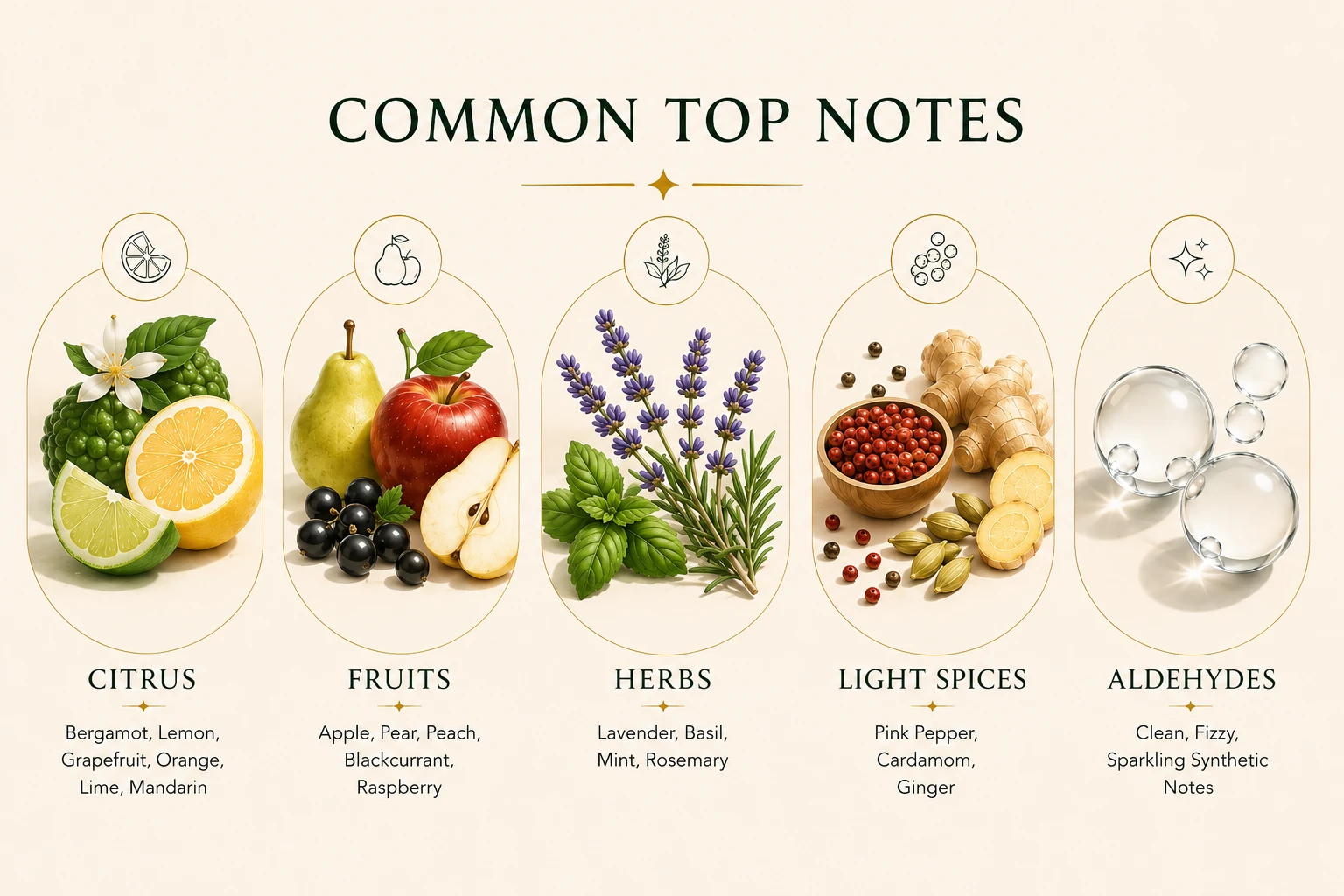
Top notes are what you smell immediately after spraying a fragrance. They are light, volatile
molecules that evaporate quickly, typically lasting 5 to 30 minutes. These notes are designed to
attract your attention and create an inviting opening.
Top notes are often why you love a fragrance at first spray, but they fade the fastest. Never judge a
fragrance by its top notes alone — wait for the heart to develop on your skin.
Common top notes — the bright, volatile opening that fades within the first half hour.
Heart Notes: The Character
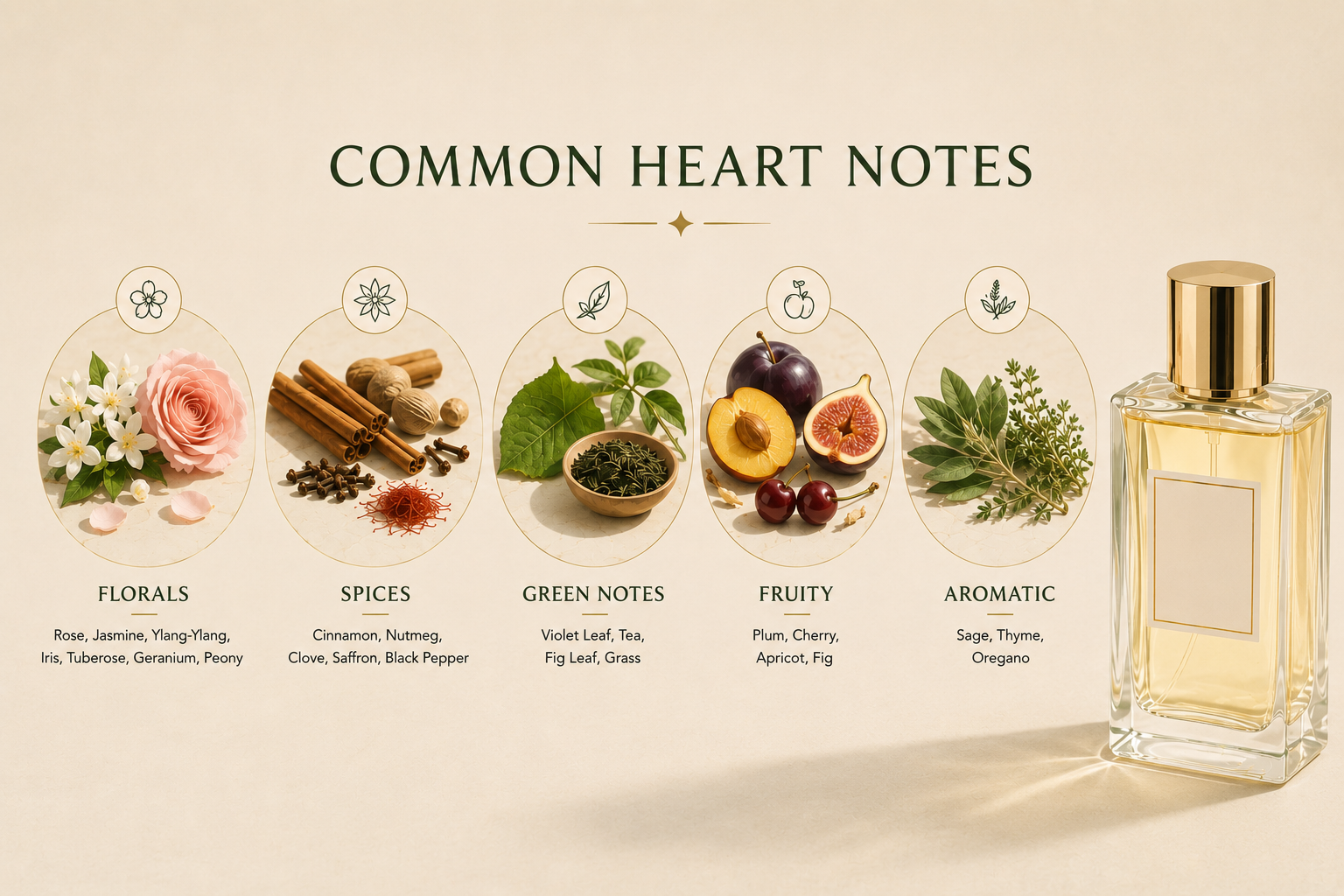
Heart notes (also called middle notes) emerge as the top notes begin to fade, usually 15 to 45
minutes after application. They form the core identity of the fragrance and last 2 to 4 hours. This
is what most people will smell on you throughout the day.
The heart is where you find a fragrance's true personality. Two fragrances can share the same top
notes but smell completely different once the heart develops.
Common heart notes — the soul of the fragrance, emerging as the top notes recede.
Base Notes: The Foundation
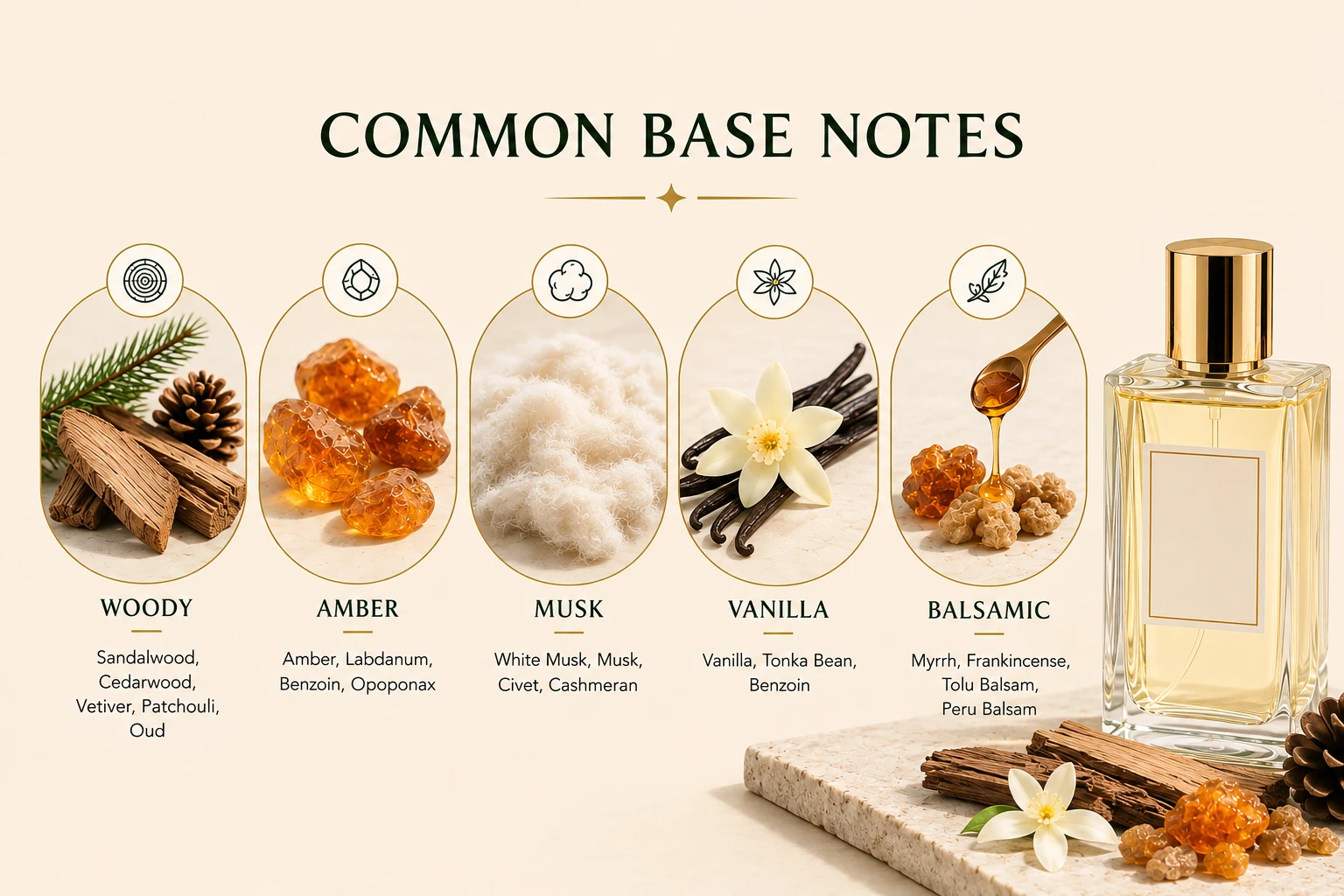
Base notes are the deepest, heaviest molecules in a fragrance. They emerge 30 minutes to 2 hours
after application and can last anywhere from 4 to 12+ hours on skin. Base notes provide depth,
warmth, and longevity, anchoring the entire composition.
The base is what people smell on your collar hours later. It's the lasting memory of your fragrance,
so pay special attention to base notes when choosing a signature scent.
Common base notes — the deep foundation that lingers long after the opening fades.
Key Ingredients Every Fragrance Lover Should Know
These are some of the most celebrated and widely used ingredients in perfumery. Knowing them will help
you decode any fragrance description.
Bergamot
Natural · Citrus
A bitter citrus fruit from southern Italy. Bright, slightly floral,
and subtly spicy. Found in the opening of nearly every classic cologne.
Rose
Natural · Floral
The queen of flowers in perfumery. Ranges from fresh and dewy
(Turkish rose) to deep and honeyed (Taif rose). Used in men's and women's fragrances alike.
Jasmine
Natural · Floral
Rich, sensual, and intoxicating. Jasmine absolute is one of the
most expensive ingredients in perfumery. A staple heart note in luxury fragrances.
Oud (Agarwood)
Natural · Woody
Formed when aquilaria trees become infected with mold. Dark,
complex, smoky, and animalic. One of the most prized and expensive raw materials in the world.
Sandalwood
Natural · Woody
Creamy, warm, and milky with a soft sweetness. Indian Mysore
sandalwood is the gold standard. Creates a smooth, luxurious base in any fragrance.
Vanilla
Natural · Gourmand
Warm, sweet, and comforting. Used in everything from fresh colognes
to rich oriental perfumes. One of the most universally liked ingredients in all of perfumery.
Vetiver
Natural · Earthy
Distilled from the roots of a tropical grass. Smoky, earthy, woody,
and slightly green. A foundation ingredient in many men's colognes and unisex fragrances.
Ambroxan
Synthetic · Musky
A lab-created molecule inspired by ambergris. Warm, slightly woody,
and skin-like. The dominant base note in Dior Sauvage and many modern fragrances.
Tonka Bean
Natural · Gourmand
Sweet and warm with notes of vanilla, almond, cherry, and cinnamon.
Adds depth and coziness to fall and winter fragrances.
Iris (Orris)
Natural · Floral/Powdery
Extracted from iris root aged for 3 to 5 years. Powdery, elegant,
and buttery. One of the most expensive natural ingredients, found in luxury niche fragrances.
Patchouli
Natural · Earthy
Rich, dark, earthy, and slightly sweet. Aged patchouli develops a
deep, wine-like complexity. Essential in oriental and chypre fragrance families.
Musk
Synthetic · Skin-like
Originally from musk deer, now entirely synthetic. Clean, warm, and
skin-like. Nearly every modern fragrance contains some form of synthetic musk in its base.
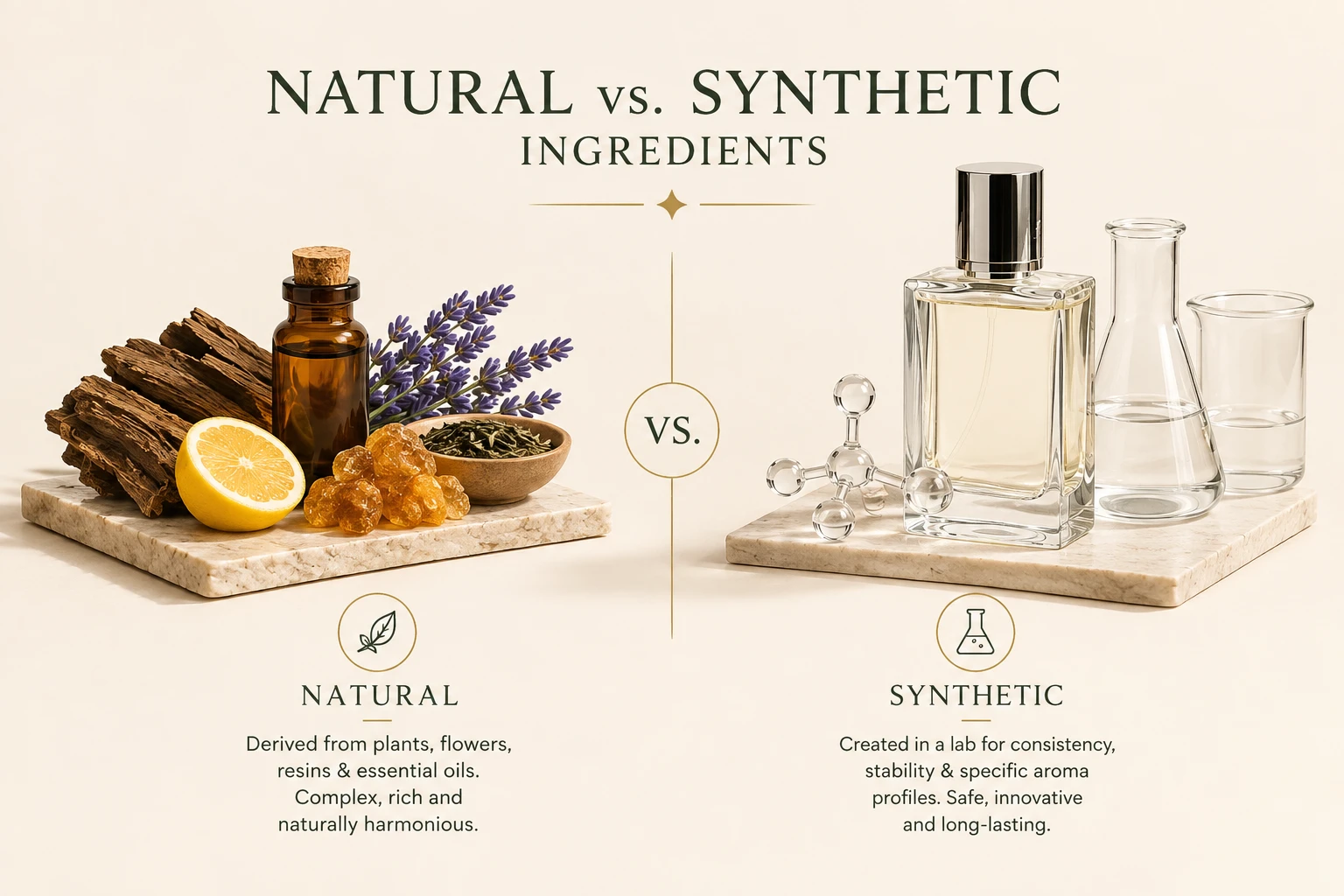
Natural vs. Synthetic Ingredients
Modern perfumery uses both natural extracts and lab-created molecules. Neither is inherently better — the
best fragrances combine both to create scents that are richer, longer-lasting, and more consistent than
either could achieve alone.
Many iconic fragrances owe their character to synthetic breakthroughs. Chanel No. 5 was revolutionary
specifically because it embraced aldehydes — a class of synthetic notes that gave it an abstract,
sparkling quality no natural ingredient could replicate.
Modern perfumery blends natural extracts with lab-created molecules to achieve effects
neither could alone.
Popular Fragrance Accords
An accord is a blend of two or more notes that combine to create a new, unified scent impression — like
mixing colors to create a new shade. These are the most common accords you'll encounter in fragrance
descriptions.
Fougere (Fern)
The backbone of men's fragrances for over a century. Clean, fresh, and
slightly herbaceous with a barbershop quality.
Lavender + oakmoss + coumarin (tonka)
Chypre
Sophisticated and earthy with a mossy, woody character. A classic
framework for elegant perfumes.
Bergamot + oakmoss + labdanum + patchouli
Oriental (Amber)
Warm, sweet, and sensual. The go-to accord for evening and cold-weather
fragrances.
Vanilla + amber + spices + resins
Aromatic
Fresh and herbaceous, often used in sporty or casual men's fragrances.
Clean without being boring.
Sage + rosemary + lavender + citrus
Aquatic (Ozonic)
Fresh, clean, and watery. Evokes the ocean, rain, and sea breeze.
Popular in modern summer fragrances.
Calone + marine notes + citrus + light musk
Gourmand
Sweet and edible. Inspired by desserts and confections. A modern
category that has exploded in popularity.
Vanilla + caramel + chocolate + praline + coffee
How to Read a Fragrance Note Breakdown
When you see a fragrance listing with notes, here's how to interpret what you'll actually experience:
The Note Pyramid
Top notes tell you what the fragrance smells like in the first 5 to 15 minutes.
These are the "opening" — bright, light, and attention-grabbing.
Heart/middle notes are what you and others will smell for most of the day. This is
the fragrance's true identity.
Base notes are what lingers on your skin and clothes 4+ hours later. They're the
lasting impression.
Tips for Note Reading
Notes are not ingredients. A "leather" note doesn't contain actual leather — it's a
blend of ingredients that creates the impression of leather.
Order matters. Notes listed first within a category are typically the most
prominent.
Context changes everything. Rose smells different next to oud than it does next to
lemon. The same note can feel completely different in different compositions.
Your skin is unique. Body chemistry, pH, and moisture levels all affect how notes
develop on you. A fragrance that smells sweet on one person might lean smoky on another.
Note lists are marketing tools. Perfumers may list appealing ingredients
prominently while downplaying synthetic molecules that actually drive the scent. Use note lists as a
starting point, not gospel.